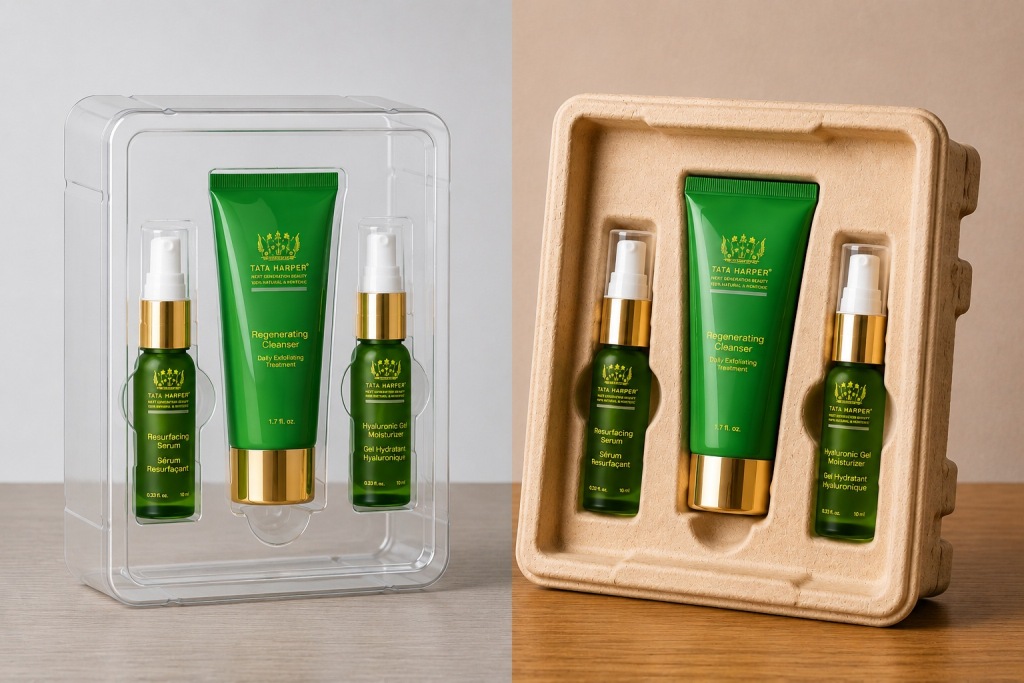
In the cosmetics industry, both transparent blister trays and eco-friendly molded pulp trays have their own unique advantages. If I had to choose between the two, I would be more inclined toward molded pulp packaging for long-term brand value and sustainability, although transparent blister packaging still has strong advantages in product presentation and shelf appeal.
Transparent blister trays are widely used in cosmetics because of their excellent display effect. Consumers can directly see the product color, texture, and appearance through the clear packaging, which enhances visual attraction and increases purchasing desire. For premium cosmetics such as lipsticks, serums, or skincare sets, blister packaging creates a modern, clean, and luxurious image. In addition, blister trays are lightweight, highly precise, and suitable for mass production, making them ideal for products requiring strong visual merchandising.
However, blister packaging also has obvious disadvantages. Most blister trays are made from plastic materials such as PET or PVC, which creates environmental pressure and recycling challenges. As global consumers become increasingly concerned about sustainability, excessive plastic packaging may negatively affect a brand’s environmental image. Furthermore, high-quality transparent blister trays with customized structures or premium finishes can significantly increase tooling and material costs.
On the other hand, molded pulp packaging has become increasingly popular in the cosmetics industry due to its environmentally friendly characteristics. Made from renewable fibers such as sugarcane bagasse, bamboo pulp, or recycled paper, molded pulp trays are biodegradable, recyclable, and plastic-free. This aligns perfectly with the sustainability goals of many beauty brands and appeals strongly to environmentally conscious consumers. The natural texture and earthy appearance of molded pulp also create a premium “eco-luxury” feeling, especially for organic skincare and clean beauty products.
From a protection standpoint, molded pulp trays also perform well. Their cushioning structure can effectively absorb shocks during transportation, reducing damage risks. In terms of procurement costs, molded pulp tooling can sometimes be more economical than high-end blister molds, especially for medium- to large-volume production. Additionally, rising global regulations on plastic reduction are making pulp packaging a more future-oriented investment.
Nevertheless, molded pulp packaging is not perfect. Compared with transparent blister trays, its product visibility is weaker. Consumers cannot directly see the product unless combined with a paper box window or additional design elements. Surface smoothness and dimensional precision may also be lower than plastic trays, which can affect the ultra-premium appearance required by some luxury cosmetic brands.
From the consumer experience perspective, the choice largely depends on brand positioning. Consumers seeking luxury and visual sophistication may still prefer transparent blister packaging, while younger consumers and environmentally conscious buyers increasingly favor sustainable molded pulp solutions. Today, many global cosmetic brands are gradually transitioning from plastic to fiber-based packaging in order to strengthen their environmental responsibility and brand differentiation.
Overall, transparent blister packaging represents visual appeal and precision, while molded pulp packaging represents sustainability and future trends. In my opinion, as environmental awareness continues to grow worldwide, molded pulp trays will become the more competitive and influential packaging solution in the cosmetics industry over the long term.